
Finding of the Relics of Elder Avvakum (Vakarov)
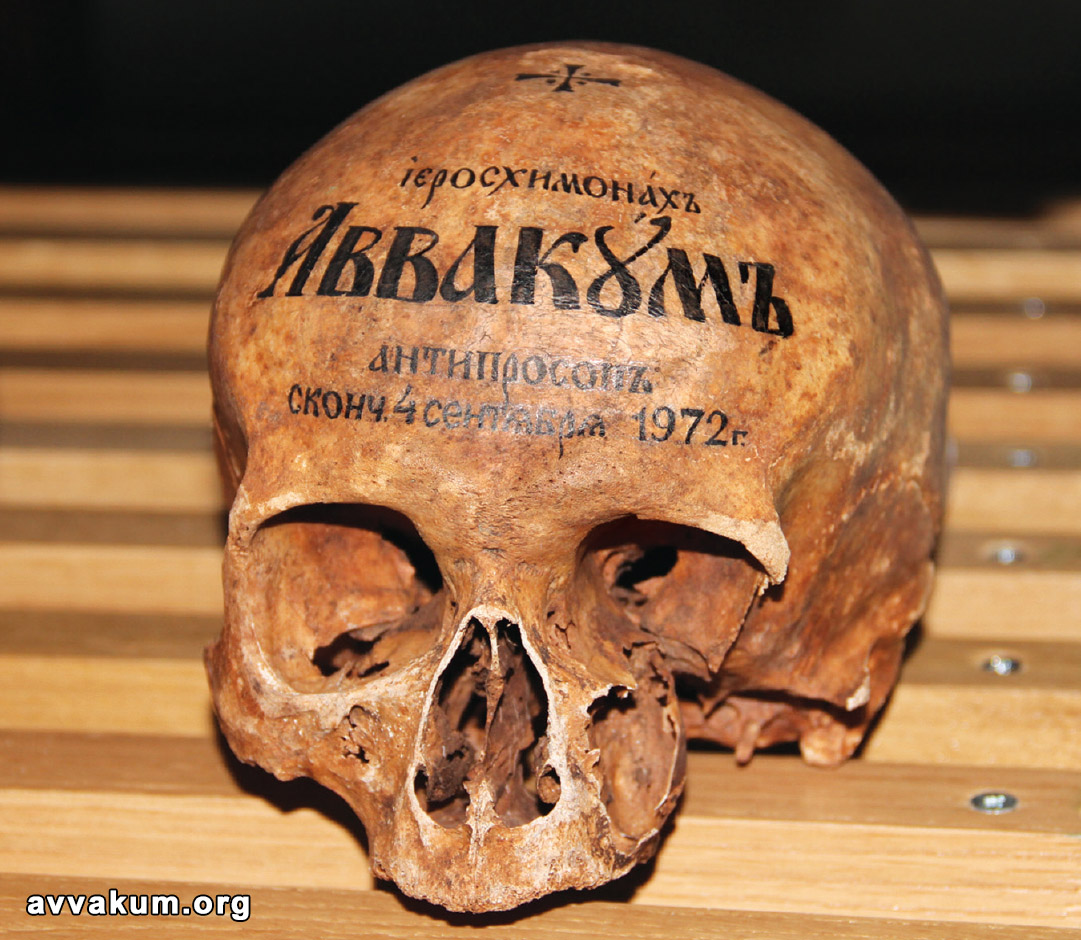
Skull of Fr Avvakum (Vakarov) (honey-coloured/brownish hue) from the ossuary of St Panteleimon Monastery
In 2017, with the blessing of the Council of Elders of the Monastery of St Panteleimon on Mount Athos and after a long hiatus of about fifty years, the ancient Athonite tradition of digging up the bodies of monks buried in the monastery and moving their skulls to the monastery ossuary was resumed.
The uncovering of the remains takes place as follows. Three years after the death of a monk, his remains are exhumed and examined. If his skull and bones are of a waxy (yellow-brown) hue, it is deemed that he was a monk of righteous and holy life, whereas if the bones are white, he is deemed to have been pious. On occasion, the tissues of the body of the deceased are not entirely degraded, in which case they are reburied and left there until only the bones remain. According to the Athonite tradition, a body that is “not accepted by the earth” indicates that the departed monk was not lacking in sins. The brethren then begin to pray all the more fervently for him and through prayer ultimately obtain the remission of his sins and the cleansing of his soul.
One of the first sets of remains to be uncovered in St Panteleimon Monastery after the more than 50-year hiatus, in May 2017, were those of Hieroschemamonk Avvakum (Vakarov), who had departed this life in 1972. This was done on the eve of the Feast of All Russian Saints of Mount Athos, which is kept in St Panteleimon Monastery on 7/20 May. The brotherhood of St Panteleimon’s took part in the uncovering of the relics. Yannis Ipsilantis was also there, as he wanted to be personally present at the exhumation and to this end came to Mount Athos specially owing to his great love and respect for Fr Avvakum.
At Fr Avvakum’s grave, with the blessing of Abbot Evlogii, a service of intercession for the departed was served according to the Paschal rite, after which the digging began while “Christ is risen…” was sung.
According to the Athonite tradition, monks are buried without a coffin and the body is wrapped in the mantia. Stones are placed on either side of the head to prevent the skull from being crushed under the pressure of the soil. After they dug all the way down to the stones, while still singing “Christ is risen…”, they removed the skull from the grave. At that moment, the mood of all those present was greatly lifted, since the skull had a waxy-brownish hue and was covered by a thin oily film.
After the skull was uncovered, the process of digging continued, initially with three people, though another priest joined later. All this time, Yannis Ipsilantis, who had for many years worked at obediences under Elder Avvakum, was sitting next to the grave with tears of joy running down his face at this unusual ‘encounter’ with Fr Avvakum.
The atmosphere was spiritual and prayerful as one bone after another was dug up from the earth. They had been below the ground for 45 years, and they were thus washed in water after being brought to the surface, and then laid to dry in the sun.
With the abbot’s blessing, the Elder’s head was brought to the monastery ossuary, a special store where the skulls of the deceased monks of the monastery are kept. It has remained there to this day
Since the uncovering of Elder Avvakum’s venerable remains, miracles have been recorded at his relics and these have continued to occur to this day.

Archimandrite Eulogius, Abbot of St Panteleimon Monastery, serves a memorial service for Hieromonk Avvakum, September 2018